Monday, April 30, 2007

Reaction to Cheney’s Initiation of Anti-China War Mongering

Reaction to Cheney’s Initiation of Anti-China War Mongering

On February 16, 2007, Vice President Cheney, after visiting Pakistan, proclaimed that China’s increase in military budget was a threat to the world. This hot-air balloon was reflected in world renowned newspapers such as the International Herald Tribune, Wall Street Journal and New York Times. The reports noted remarks by high level political persons, some of whom are in the Bush Administration, cautioning against exaggeration.

As far back as August 18, 2006, Sha Zukang, China’s Ambassador to the United Nations told the British Broadcasting Corporation Radio (BBC) that US concerns about his country’s “burgeoning military might” were misguided. He goes on to say, “It’s better for the US to ‘shut-up’ . . . China’s military build-up is not threatening anyone.”

On March 5th, US Treasury Secretary Henry Paulson was quoted as saying “I would say that our relationship with China is multifaceted and it’s a very important relationship for the US and I don’t believe we need to make China an enemy. If we manage the relationship - - the overall relationship with China properly, it’s going to benefit both of our countries for a long time to come.”

Of course, the Chinese responded that they were increasing the military budget by 18% from 2006-7. On March 6th, the PLA issued a report stating that “China’s defense expenditures in 2005 of $30.6 billion accounted for only 1.35% of the country’s GDP, while the United States and Britain spent 4.03% and 2.71% of their GDPs on defense.” Their intent is to increase the technical capability of their military forces and keep up with modernization. In fact, on March 2nd, China’s Commission of Science, Technology and Industry for National Defense issued a new policy, encouraging private companies to invest in the national defense industry.

In February, responding to the backlash against the destruction of its own space satellite, China had issued a white paper disclosing their space activities and proposing discussions with the USA to come to an understanding of militarization of outer space. One can hardly consider the obliteration of its own satellite by self- guided missile, a threat. Rather, it serves notice that the USA monopoly of outer space military advantages is over. Undoubtedly, the Russians have a similar capability. Nonetheless, the US has shunned invitations to have an international agreement on non-militarization of outer space. We are now awaiting a proper response from the USA.

One can suspect that Vice President Cheney was beginning a new set of presumptions, exaggerations and, if I may use the term, lies about China’s military prowess and intent. China has never been involved in any international military conflicts (with one short-lived incident in the 20th Century). This is par for the course for the Bush Administration. We know they directed the development of intelligence stories with regards to Iraq, where we never found any weapons of mass destruction. It was our invasion that created mass destruction in Iraq itself. We lost over 3,000 soldiers and have caused almost every Iraqi family to lose a member due to the conflict our invasion released.

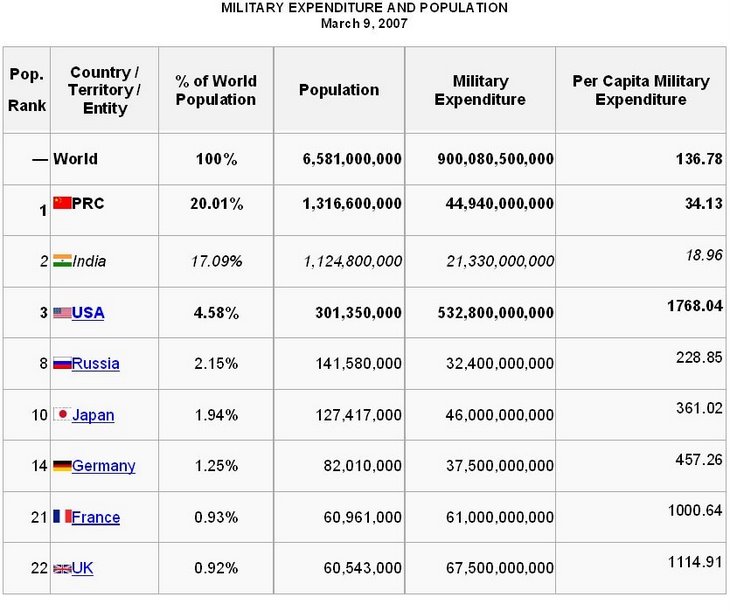
As for the facts of militarization, we attach a table below which shows the world’s total military expenditure, as well as that of nine countries. This chart compares each country’s published military expenditure, population and the percentage of their population in the world’s total. The last column calculates the per capita military expenditure of each nation. The results are astounding. The United States is almost $1,800. China is approximately $35.

[Please note: This Chart is available towards the bottom of our blog in a larger, more readable format; just scroll down.]


We calculated and grouped the per capita military expenditure of India (which has the lowest per capita of roughly $19), with Russia (approximately $230) and China for a total of approximately $38. Note that these three countries are not dominated by American military structure and, in their independence, have joined together for development. Hence, we view them as a special group to compare to the US military position. Whichever way you look at it, the United States per capita expenditure is 46 times the combined per capita expenditure of India, Russia and China.

Where is the logic in assuming that a country with 1.3 billion people and 20% of the world’s population, spending only $35 per capita for its military establishment, is seeking domination anywhere in the world against existing interests of the USA with only 4.6% of the world’s population but an expenditure of 533 billion dollars for 2007 (or a per capita expenditure of $1,769).

Please, someone out there, give me the logic. If you can’t, then it doesn’t exist and we must conclude that Mr. Cheney and the forces in the Bush Administration, for which he is spokesman, are on the verge of concocting a new series of lies to destabilize peaceful relations. This is hardly the way to resolve real differences that have developed in our economic relations. There, again, please note that the negative trade balance of the US to China and the US indebtedness of over half a trillion dollars could be relieved if we were to sell them the heavy equipment and technology which they continue to tender as a major step in balancing our accounts. Furthermore, China is ready to invest in USA industries to produce commodities that they can import which would reduce the negative trade balance considerably. The solutions are there. The political economic policies of the USA are not defensive, but offensive in making it appear that China is an enemy and we should fear their military.

China’s foreign policy is to rise peacefully as an economic power. It has proven and intends to continue to make win-win trade and investment deals with all countries, particularly developing countries which will have an opportunity to improve their own states. Call a spade, a spade. Cheney is throwing up a balloon which lies in the hope that it diverts attention to the recalcitrants of the USA to work as equals with China, recognizing the inevitability of China’s future rise. The resolution of conflicting interests, from the Chinese point of view, is to be handled diplomatically without any allusions to the military.


Warfare in orbit is only news when China does it
The Real 'Masters of Space'


By Karl Grossman

(Appearing in April 2007 issue of Extra! The Magazine of FAIR--The Media Watch Group)

As a graphic proclaiming "Red Storm" flashed on the screen, CNN anchor Lou Dobbs intoned: "Communist China tonight refusing to explain its motives for conducting its first-ever anti-satellite missile test. That test, the latest in a series of dangerous new challenges by the Chinese military to this country’s interest."

He threw it to correspondent Christine Romans, who declared, "Defense experts see a pattern of behavior that highlights China’s strategy to exploit American weakness." Romans went to John Tkacik of the Heritage Foundation, who, she reported, "says that American policymakers refuse to recognize China’s hostile intentions toward this country."

The segment on Lou Dobbs Tonight (1/24/07) didn’t mention anything about the U.S. military's space strategy of recent years (Extra!, 5-6/99). There’s not a word about a key 1998 U.S. strategy document, the U.S. Space Command’s Vision for 2020, which envisions space-based laser weapons zapping targets on Earth, and speaks of the U.S. military "dominating the space dimension of military operations to protect U.S. interests and investment" and "integrating Space Forces into war-fighting capabilities across the full spectrum of conflict."

Nor was mention made of the 2001 Rumsfeld Commission report, which declared, "In the coming period, the U.S. will conduct operations to, from, in and through space to support its national interests both on the earth and in space." The Commission to Assess United States National Security Space Management and Organization, chaired by Defense Secretary Donald Rumsfeld, also urged that the U.S. president "have the option to deploy weapons in space."

Also left out was a new U.S. National Space Policy adopted by the White House last year that took a still more aggressive U.S. position on space warfare, announcing that the U.S. will "develop and deploy space capabilities that sustain U.S. advantage."

Just as the continuing U.S. development of space military capabilities wasn’t reported, nor were the repeated efforts led by China, Russia and U.S. ally Canada to have the 1967 Outer Space Treaty, the basic international agreement setting aside space for peaceful uses, broadened to include a ban on the deployment, testing or use of weapons in space--or the U.S. opposing this initiative, all but alone at the U.N., in vote after vote.

Instead of placing the story in context, explaining the precipitating factors, China’s successful destruction of one of its old satellites was simply labeled--in a banner across the screen--as "Communist China’s Rising Threat to the United States."

The New York Times (1/19/07) was only somewhat better. After the jump, its lead story ("Flexing Muscle, China Destroys Satellite in Test") did inform readers that China has "been trying to push a treaty to ban space weapons." No reference, however, was made to the U.S.'s lonely and sustained opposition to this.

And the quote on which the story is hung, in the fourth paragraph on Page 1, is Jonathan McDowell, a Harvard astronomer, declaring: "This is the first real escalation in the weaponization of space that we’ve seen in 20 years." Where exactly has McDowell been as the U.S. has ratcheted up its space warfare program over the past two decades?

The space industry trade newspaper, Space News (1/22/07), emphasized the folly of banning weapons in space in its front-page story about the test ("China’s ASAT Test Widely Criticized, U.S. Says No New Treaties Needed"). It filled six of the first eight paragraphs of the piece with long, virtually unbroken quotes from an anonymous "U.S. State Department official."

A key quote from the unnamed official: "Arms control is not a viable solution for space. For example, there is no agreement on how to define space weapons." How about "weapons in space"?

Aviation Week & Space Technology (1/17/07) revealed the January 12 Chinese test on its website in an article that omitted any mention of the U.S. space military program. But it did state, "China’s growing military space capability is one major reason the Bush administration last year formed the nation’s first new National Space Policy in 10 years."

In a subsequent full-page editorial, headlined "China’s ASAT Test: Irresponsible and Against International Norms," Aviation Week (1/29/07) declared that news of the test "that we broke on our website…should not come as a surprise. While the precise timing of the test may have startled most of the world…the People’s Liberation Army has been signaling its intent to master the space realm for more than a decade."

Aviation Week might have acknowledged that "Master of Space" is not a motto coined by the Chinese, but by the U.S. Air Force Space Command’s 50th Space Wing in 1992the words emblazoned to this day above the entrance of its headquarters in Colorado.
The publication made no explicit mention of China’s efforts to ban weapons in space and U.S. opposition to that, but it did remark that the general hand-wringing about "militarizing space" or an "arms race in space" that we have noticed in some quarters strikes us as downright silly.

First of all, space has been militarized practically from day one…. And even if the genie could be put back in the bottle, why should it be?... Today, the U.S. is understandably reluctant to invite the nations of the world to discuss restrictions on a technology in which it is preeminent. No armed forces enjoy the advantages of the orbital high ground more than those of the U.S.

"When I say last week’s coverage was bad, I mean textbook bad, without even token context," Brian Dominick wrote for the New Standard website (1/25/07). "The only background we’re offered--in some articles--took the form of acknowledgement that the U.S. has the capability to nix Chinese satellites. But even that came in a paraphrase attributed to an expert who appears to be some kind of U.S.-space-domination cheerleader."

Among the pieces he singled out was an Associated Press story (1/23/07) that spoke about the test by China "carried out under the auspices of its highly secretive, military-dominated space program." Dominick observed: "It’s hard to think of better terms to describe the U.S. space program other than by adding ‘profit-aware.’ But you’ll never see ‘secretive’ or ‘militarized’ as adjectives describing NASA--at least not in the AP."

Great detail need not be offered to provide context. For instance, the British journal New Scientist (1/27/07) simply noted:

Despite protests from the Bush administration over China’s action, analysts point out that the U.S. has consistently refused to discuss a new UN treaty on the peaceful uses of outer space. Instead, it will this year spend at least $1 billion on anti-satellite weapons research.


The mainstream U.S. media coverage of the Chinese test--riddled with omissions and jingoism--is no surprise to Bruce Gagnon, who for 15 years has been coordinator of the Global Network Against Weapons and Nuclear Power in Space (www.space4peace.org). He tells Extra!:

While China's ASAT test is troubling, it is also hypocritical of the U.S. to criticize them for doing something that our country has been doing since the 1980s. The Pentagon today is developing a host of ASAT weapons technologies that would give them the ability to knock out other countries’ satellites. Sadly, the American people don't know anything about this because the corporate-dominated media refuse to cover the story.

Every year, he notes, the Global Network presses the space militarization issue by holding a Keep Space for Peace Week. "We send information out to the mainstream media locally and nationally but they completely ignore our efforts," he says. "You'd think that the fact people are holding positive actions to educate the public about preventing a news arms race would be newsworthy." Last year, during the week of demonstrations and talks, the bellicose new National Space Policy was announced (DATE), and thus "all the more reason for a story about a global movement working to prevent the weaponization of space. But nothing was reported on it."

"Why do the mainstream media not report on a growing international movement to keep space for peace?" Gagnon asks.

Could it be that much of the media today is under the control of the very corporations who will benefit, directly or indirectly, from a new arms race in space? The Pentagon has long bragged that Star Wars will be the largest industrial project in the history of the planet. In order to create the fear and acceptance of such a plan, the media must manage the news around this issue so that the American people remain compliant.

The move by the U.S. to turn the heavens into a war zone "has all the elements of a big story--money, power, domination, corruption," says Gagnon. "But the corporate-dominated media rarely go near it. The big money is keeping a lid on this story for a reason."

Karl Grossman, professor of journalism at SUNY College at Old Westbury, is author of Weapons in Space (Seven Stories Press) and The Wrong Stuff (Common Courage Press) and host of the TV documentaries Star Wars Returns and Nukes in Space: The Nuclearization and Weaponization of the Heavens ( www.envirovideo.com).

Sunday, March 25, 2007

China... the Trade Off in having capitalist partners

We would like to share an article from Beijing Review on the impact and problems that have developed with China’s Opening to the West as it expresses itself in trade and investment relations. Without a doubt, for historic reasons of low-cost production in colonial China which has achieved modernization in only part of its country where more than two-thirds remain undeveloped, China has nevertheless emerged as a viable competitor to major capitalist countries. At the same time, it is a valued customer for raw materials from many undeveloped and developing countries, giving them opportunity for independent growth. In fact, the US has raised sharp complaints in the WTO against what they claim is China’s subsidizing exports. Of course, the US will not own up to the fact that its subsidies to cotton growers has kept the price of US cotton low and resulted in 10,000 African farmers being put out of production.

The West, particularly the US Treasury, is pinning the solution on increasing the value of Chinese currency as though a change in the means of exchange would resolve what is essentially a production problem. No doubt, some adjustments can be made in tariffs, import, and export, arrived at in reasonable negotiations and the opening of trade and investment privileges. Of course, China is making efforts to increase consumption in its own country to absorb a larger share of the GDP and rely on production for export. This is a long term process and will depend upon the rapidity with which the Hu government creates the Socialist Welfare State they promise to be in place by 2020 for 90% of the population.

A more equitable share of wealth in China will go a long way to resolve the competitive inequalities that have arisen. However, in the interim, the trade imbalances can be alleviated if opportunities for China’s imports from countries with large disproportions would help both China in its economic growth and the complaining countries would have a higher level of exports to China. The result is a more workable balance; but this means that countries like the USA must relax its policy of refusing the sale of heavy and high tech equipment to China and the right to make legitimate investments in production intended for export to China. Unfortunately, US super-power politics is in the way of logical economic decision-making, though Bush has encouraged one major technology deal.

The kernel of solution of competitive realities is clearly noted in the last paragraph of the article “A Trade Off” by Zhou Jianxiong.

----------------------------------------------------------------------

A Trade Off

Beijing Review vol. 50 no. 7

February 15, 2007

By ZHOU JIANXIONG

China's growing trade surplus has become a major concern for some of its major trade partners, such as the United States and the European Union. As the latest statistics from China's Customs Administration suggest, while the country's export growth rate fell 1.2 percentage points and that of imports rose 2.4 percentage points, the total surplus grew $75.59 billion last year to hit a record high of $177.47 billion. This proves to be a direct cause of friction between China and these trade partners. By the third quarter of last year, 70 cases of antidumping and countervailing investigations had been launched against China, making it the world's primary target of trade punitive measures. In addition, this trade surplus has brought about overheated investment in the wake of huge capital deposits building up in the banking sector, a phenomenon the Chinese central authorities have vigorously sought to control in recent years.

Many Chinese scholars and trade officials have attributed the trade surplus to the massive transfer of global manufacturing industries to China, which has boosted its export potentials, and led to an overcapacity that curbs demand for more imports. Others believe that a stronger global demand for Chinese processed goods may be the cause. This is substantiated by figures from the Ministry of Commerce showing that the trade surplus from processed products has been greater than that of general trade over the past six years. A higher savings ratio is also held accountable for the trade surplus, as it gives rise to an accelerating pace of investment as well as inadequate domestic consumption.

Whatever the causes, this trade surplus remains and is still rising, and given its status in the globalization process, cheap labor and other resources, and current stage of social development, China is likely to maintain an overall surplus in foreign trade over a relatively long-term period.

This, however, does not mean that the Chinese Government is taking an indifferent attitude toward the issue. On the contrary, various measures have been adopted recently to curb the rising surplus, including setting up a managed floating exchange rate system, lowering the rate of export rebate, and concluding of procurement contracts worth billions of dollars abroad. Chinese leaders have reiterated on many occasions that China has no intention of pursuing a huge trade surplus with any other countries, and the Minister of Commerce Bo Xilai has declared the reduction of trade surplus one of his top priorities for 2007. Conceivably, a series of new policy readjustments will be made to attain the goal in the foreseeable future, ranging from a more liberalized floating exchange rate system, replacing export incentives with new policies that encourage import and investment overseas, to optimizing the lineup of export commodities and taking fresh steps to stimulate domestic consumption.

Some Western observers have pinned their hopes on the appreciation of the Chinese yuan, assuming that a higher exchange rate of renminbi will be a miraculous cure to easing the trade surplus. This is only correct on paper, for China's trade surplus does not originate from an imbalance of international trade, but is a result of the changing setup of global manufacturing activities and international division of labor and market. Under such circumstances, China really needs outside help from some of its trade partners to cut its trade surplus, such as lifting restrictions on China's purchase of hi-tech products and clearing the barriers to Chinese business investment abroad.

Friday, March 2, 2007

The Emerging Hu-Wen-Zeng Troika

[Please note: Due to travel and inclement weather this blog was not posted according to schedule, therefore it will remain posted until Monday March 12. I am sorry about this problem... Alan Maki]

Dear Colleagues,

On January 16th we sent you comments on the Herald Tribune Article that we interpreted as a trial balloon to push Hu into the background of the PRC’s international relations and pull Zeng forward. We suspected, and still do, that this move was inspired by the anti-Hu centrist super modernization wing of the Communist Party, together with foreign influence to push China on a capitalist road and divert the Hu/Wen moves to rebalance the distribution of wealth and develop a Welfare State. We included information about Zeng’s position as the main advisor to Jiang Zemin who followed the ultra-modernization line.

We have now received a two-part article titled “The Emerging Hu-Wen-Zeng Troika,” which appeared in the Hong Kong Asia Times on February 21st. It appears that Hu, at this time, remains the super diplomat in control of the direction of the government of China. He, undoubtedly, will continue a deft but public crusade to clean out the corruption that has categorized decisive levels of the Communist Party and government officials, many of whom are or were Party leaders (we learned a year and a half ago that 78 billion dollars had been sent overseas by some 4,500 top cadre who fled the country and are still being sought). We are now aware of his breaking the Shanghai Gang, of which Zeng was an important advisor to the previous regime under Jiang.

Hu, as you will note, has turned over the role of organizing the cleanup of corruption in the Communist Party at this year’s 17th Congress in the Fall of this year. We have a very strong feeling about Hu’s genius as a diplomat and believe it possible that he could manage exemplary results from such a troika. Of course, Wen has always closely collaborated with Hu. Zeng, who is undoubtedly a highly competent leader and original thinker, might be groomed by them into a new direction and a strong bid for the future on a socialist road rather than a questionable capitalist direction.

Therefore, we hope that all the information you glean from the enclosed copy of Wu Zhong’s article by the China editor of Asia Times will give you considerable information to develop your own concept of the build up and results of the forthcoming congress whose main theme is the elimination of corruption and the forwarding of programs to build a harmonious society, rather than urging individuals to get rich quick.

Sincerely,
Sidney J. Gluck

-----------------------------------------------------------


Asia Times (HK)
2/21/07


SUN WUKONG
The emerging Hu-Wen-Zeng troika
By Wu Zhong, China Editor

HONG KONG - Chinese President Hu Jintao is in firm command of the preparations for the Communist Party's 17th Congress scheduled to be held in the autumn. This is a sure sign that Hu's authority as the supreme leader of the party and the country will be truly established in the upcoming five-yearly party congress and that he has walked out of the political shadow of predecessor Jiang Zemin.

Sources in Beijing confirm a report in the latest issue of The
Mirror, a Chinese-language pro-Beijing China-watching monthly based in Hong Kong, that two leading groups have been set up to take charge of the preparatory works for the party congress: one to oversee the draft of the keynote report to be delivered at the op ening that will set the party line for the next five years, the other to take care of personnel matters - including the selection of delegates and, more significant, the election of the new Central Committee.

With Hu's approval, Premier Wen Jiabao, now ranking No 2 in the party hierarchy, has been assigned to head the political-report-drafting group and Vice President Zeng Qinghong, now ranking No 5, to lead the personnel group. This indicates that a Hu-Wen-Zeng troika has been formed to lead the party's 17th National Congress and likely to be become the core of the party's leadership afterward, the sources say.

This debunks some earlier rumors, one of which had Jiang demanding that Wen step down if Hu wanted to force Jia Qingling, ranking No 4 in the Politburo's Standing Committee and also chairman of the Chinese People's Political Consultative Conference, and the ailing Vice Premier Huang Ju, ranking No 6, to retire at upcoming congress.

Both Jia and Huang are seen as Jiang's proteges. Another rumor said Hu was being urged to cede the presidency to Zeng, suggesting the two were locked in a power struggle ahead of the party meeting.

The keynote political report to a party congress is normally delivered by the party's leader. In the history of the Chinese Communist Party, there were a few exceptions in Mao Zedong's time when the Great Helmsman had his hand-picked successor read the report instead, though all of his designated successors proved to be politically short-lived.

So it is believed the political report will be delivered by Hu himself, though Wen is now overseeing its drafting. The Mirror report said Wen has already recruited elite party theorists and researchers from top think-tanks into the drafting group.

The report is expected to elaborate on Hu's idea of "building a socialist harmonious society" and "pursuing a harmonious world". Sources say that following party tradition, it is essential for Hu t o have his own ideas developed into the party's guiding ideology. Only in this way can his supreme leadership truly be established. From this viewpoint the drafting of the political report is a very important task. So to have Wen head the drafting group shows Hu believes the premier will faithfully accomplish the task.

And the approval of the political report (which is surely expected) means Hu's idea will be officially adopted as the party line. Some sources say the party constitution is also likely to be revised to include Hu's line as the party's theoretical guideline parallel with Deng Xiaoping's "thought" and Jiang's "three represents" theory.

Adoption of this line will formally mark the opening of the Hu era. "No doubt, the next five years will be strongly branded with the Hu stamp," said Li Ji, former vice president of the Chinese Academy of Social Sciences (CASS), in an interview with The Mirror.

In the division of labor in the current Politburo Stan ding Committee, Zeng's portfolio is to oversee the party's construction and organization affairs - a job Hu himself had concentrated on until he became party chief in late 2002. As such, Zeng is concurrently president of the Central Party School, the training center for senior cadres. And the party's Central Organization

Department, which handles the appointment and promotion of senior party and government officials, is directly under Zeng's supervision.

Given this portfolio, it is logical for Zeng to be assigned to head the preparatory group on personnel affairs. Nevertheless, it still shows that Zeng, who used to be regarded as a protege of Jiang and a key member of the so-called Shanghai clique, has won the trust and become an ally of Hu.

The reshuffle of personnel in the upcoming party meeting is so important to Hu that it would simply be unthinkable to have a rival in charge. Hu needs loyal cadres to implement his line. Or, as Mao put it: "Once the party line is established, c adres become the key factor" for implementation of the line.

Zeng's group has first to supervise the selection of 2,200 deputies from the 38 constituencies representing 72 million Communist Party members across the country. They include the 31 mainland provinces, the party's central units, the central government units, the People's Liberation Army, the paramilitary People's Armed Police, the state-owned enterprises, financial institutions under the central government, and the All-China Federation of Taiwan Compatriots (supposedly representing Taiwan).

According to the rules, 70% of the 2,200 deputies will be party and government officials. The 200-odd full members and 150-odd alternative members of the party's new Central Committee will be elected from among these 2,200 deputies during the congress. So another important task for Zeng's group is to work out a list of candidates for the new Central Committee.

Normally, all party chiefs and governors of the 31 mainland provinces are on the Central Committee. Thus all provinces are required to hold their local party congresses to pick new provincial party committees and party chiefs. This is to ensure that new blood will be injected into the new Central Committee. So far, 15 or so provinces, mostly in central and western China, have already convened their regional congresses. But economically important regions on the east coast such as Beijing, Shanghai, Tianjin and Guangdong have yet to hold their provincial-level congresses.

Analysts say Zeng will not be able to work out the list of candidates for the new Central Committee before the end of June when official reshuffles in all provinces are to be completed.

For this new round, Hu has instructed that strenuous efforts must be made to prevent the promotion of "ill" officials. In Chinese, the word "ill'' in the context of his speech has a double meaning. It refers not only to physical sickness but also to evil deeds such as corruption.

There are reasons for Hu to be concerned with the state of heath of those to be promoted. In the past, a couple of Politburo members died soon after they were elevated to the power center. The current example is Huang Ju, who is very ill, reportedly suffering from cancer of the pancreas since early last year. Hu's instruction signals that Huang definitely will have to say goodbye to his political career this autumn.

But Hu is surely more worried that corrupt officials might be promoted. In the past quite a number of corrupt officials were promoted to higher positions. Disgraced Shanghai party chief Chen Liangyu scorned the Central Commission for Disciplinary Inspection's warning that his secretary Qin Yu was suspected of involvement in a corruption scam, but insisted on promoting Qin to head a district in the city. Eventually, the CCDI's investigations of Qin led to the exposure of Chen himself. This has become a well-known example of "ill-promotion" am ong Chinese officials.

Sources say that an important condition in the selection of deputies to the party congress and of candidates for the new Central Committee is that they must be free of any suspicion of corruption. In this regard, the CCDI and regional party anti-graft watchdogs may play a role in the selections.

However, given the runaway protectionism at regional levels and nepotism in today's China, it will indeed be a backbreaking, if not impossible, mission for Zeng's group to be sure that all party cadres promoted ahead and during the party's 17th National Congress are clean.

Subject: A Disturbing Trial Balloon
Date: 1/16/2007 5:54:38 PM Eastern Standard Time
From: SJGluck


I would like to share a story from the International Herald Tribune. There appears to be a move to push Hu Jintao out of the Presidency of the State and give this position to Vice President Zeng Qinghong.

No doubt, there is a move to reduce the effectiveness of Hu Jintao, who is leading the country to a positive role in giving attention to poverty, the peasants and the conditions of workers, in other words, social security with equal emphasis to the question of economic growth. This has been the consistent move by Hu from the very beginning even in the first two years when he had considerable difficulty getting rid of Jiang Zemin's office holding and influence.

I will share with you an excerpt we have from a biography of Zeng Qinghong:

"As the Deputy Director of the General Office of the CPC Central Committee from 1989 to 1993, Zeng guided Jiang, an outsider to national politics, through the inner workings of the party, military and bureaucratic structure in Beijing. He promoted Jiang's leadership and thinking, broadened Jiang's network, and became Jiang's right-hand-man. Over the 1990s, Zeng consolidated control of party organs responsible for the appointment of cadres to important political positions. As head of the Organization Department of the CPC Central Committee from 1999-2002, he strengthened Jiang's position by promoting members of the president's "Shanghai clique" to leading central and regional posts. He also helped advanced Jiang's guiding political philosophy the Three Represents."

Clearly, the objective of this underground move is to bring back the influence of the influence of Jiang Zemin, which would concentrate strictly on the GDP without true concern for the masses.

Many of you know I have said that the establishment of a Socialist Welfare State under Chinese conditions would turn out to be an early stage on the road to socialism. Under Western conditions, the Welfare State and the New Deal were liberal defensives against the USSR in the 20th century. However, there have been incursions of various degrees in every country to reduce the benefits to the masses. Although it is also true that a Welfare State in China is a defensive, unless there is a reversal of the Hu Jintao trend towards development, there would be no incursions against it. This may be a hard pill for colleagues who believe in socialism, but I ask your consideration of the actual State of Affairs.

It is quite possible that Hu has won over Jiang because of his proven superb diplomatic abilities; but we cannot know this until we observe Jiang's performance as the appointed head to lead the preparation of the 7th Plenary in the Fall of 2007 which is intended to concentrate on eliminating corruption in the CCP at the expense of reducing its numbers, but cleaning out the opportunists. We should keep our eye on the progress of this trial balloon, pro and con. We might also tune in on any slight allusions on the part of Hu himself or Wen Jibao who is definitely of the same general line of opinion as Hu.

Sincerely,
Sidney

---------------------------------

Hu is urged to cede his position to the vice president

Reuters
Wednesday, January 10, 2007
BEIJING

The Chinese leader Hu Jintao has been urged to cede the presidency to a rival-turned-ally, sources said, a step that would sweep aside two decades of established practice and let him focus on extending Communist Party power.

Political allies of Vice President Zeng Qinghong have urged that he be promoted to state president at Parliament's annual session in 2008, the sources with close ties to the top leadership said, requesting anonymity to avoid repercussions for speaking to foreign media.

It was not certain whether the proposal would be adopted, but the debate is a sign that jockeying among leaders has begun in earnest before the 17th Communist Party Congress, due sometime between September and November of this year.

"There are voices in the party that it is no longer necessary for one person to hold all three positions," one source said, referring to the presidency and the top party and military jobs all currently held by Hu.

A second source said Zeng's supporters were arguing for a return to the modus vivendi of the late 1950s and early 1960s, when power was shared by four national leaders.
The practice continued under the paramount leader Deng Xiaoping in the early 1980s, with Hu Yaobang as party chief, Zhao Ziyang as prime minister and Li Xiannian as president. After Hu's political demise, Zhao took the top party post and Li Peng was prime minister.

In a departure from that practice, Jiang Zemin was given the presidency and the top party and military posts to bolster his relatively weak position as he rose to power after the 1989 Tiananmen Square crackdown.

Jiang ruled for 13 years until 2002, when he handed the party general secretary post to Hu, who replaced Jiang as president in 2003 and military chief the following year.
Hu, who reversed Jiang's emphasis on embracing the growing ranks of rich capitalists and has instead pursued policies over the past five years lifting up the rural poor, is expected to signal a fifth-generation heir and further consolidate power at the party congress.

While some analysts said that handing the presidency to Zeng could be perceived as a sign of weakness, other political sources said it could show Hu's confidence in his grip on power. He would still hold the more influential posts of party and military boss, and would have more time to focus on internal issues to strengthen the party's monopoly on power.

"Domestically, Hu will be seen as magnanimous if he lets Zeng become president," a third source said. "It'll be a recognition of Zeng's work."
"But it's a difficult decision because Hu needs the presidency to break out into the world," the source added.


Subject: The Disturbing “Trial Balloon” is Blowing Up
Date: 2/5/2007 6:09:21 PM Eastern Standard Time
From: SJGluck

Dear Colleagues,

Following our response to the Herald Tribune article sent to you on January 16th, which was the first public appearance of a program to create sentiment for Hu Jintao to give up the presidency of China in favor of Zeng Qinghong, the point man for Jiang Zemin who was succeeded by Hu after a good deal of pressure, there has been another leap forward in the publication of an extended story in the Asia News. We are attaching the communication just received from one of our associates who is not always gung ho about China. While this article repeats much of the original, it is much sharper about Hu’s resignation than the speculative tone of the Herald Tribune original. It is now quite obvious to the writer that a campaign is developing with great assistance from outside of China itself for the shifting of Hu’s responsibilities away from the international scene.

It is precisely his position as the Head of State of the government that allows him to exercise a most sophisticated ability for diplomacy that has become the benchmark of China’s foreign policy in the past few years following Hu’s ascension to leadership.

Further, the article in Asia News puts coloration on the relationship between Zeng and Hu which totally ignores the fact that it was Zeng who was the main advisor to Jiang Zemin for all of the critical aspects of government policies that ignored the Chinese people and maintained a touch of belligerency in its foreign policy over Taiwan. It further makes references to Deng Xiaoping (who was not a top leader of the Communist Party, only a highly respected advisor because he carried the label of modernization stamp on him by Chou En Lai), allowing for unfinished references to a three man leadership of China which was changed by Deng and Jiang Zemin, giving Jiang the full power for which the scepter has passed to Hu, not without a struggle.

The removal of Hu as the top spokesman for China on the world scene would be a set back for world developments and create an opportunity for elements within China to return to policies which were intolerable at best and suspect at worst.

Stay tuned and keep your eyes and ears open. The battle between private and social interests in China is sharpened under circumstances which at the moment still favor a road towards socialism through a Welfare State. We are witnessing the acceleration of a campaign to derail the social programs in China and China’s positive relations with countries around the world.

Sincerely,
Sidney J. Gluck

PS: An afterthought: If Zeng has changed at all in the present Political Bureau structure; it is because of Hu’s influence. Any change by Zeng is yet to be tried in the responsibilities that have been turned over to him in the fight against corruption that will take place very sharply in the forthcoming 7th Plenary later this year where Zeng has been put in charge of the program. I believe that this is a test rather than an approbation of Zeng’s actions since Hu’s ascendancy following Jiang’s final relinquishing of leadership of the People’s Liberation Army (PLA).

----------------------------------------------------------------------------------

AsiaNews - www.asianews.it
Last Updated: 01/17/2007 18:57
CHINA

Hu Jintao should cede the presidency to his former rival

Sources in the Communist leadership are saying that within the party there is one faction that is pushing for Zeng Qinghong, the last member of the Shanghai gang, to replaced Hu as president. The decision should come at the next annual meeting of the People's National Congress.

Beijing (AsiaNews) - Hu Jintao has been urged to cede the presidency to Vice-President Zeng Qinghong, a rival-turned-ally, and focus on extending Communist Party power as party general secretary, sources close to the top leadership said. Mr Hu, who is president, party leader and commander in chief of the armed forces, should make the change at next annual National People's Congress.

Although it is not clear whether the request will be heeded, the fact that it is raised is a sign that a debate is going on within the top leadership of the Communist regime

"There are voices in the party saying that it is no longer necessary for one person to hold all three positions," one source said.

A second source said that this would represent a return to the system under Mao Zedong, when the top political spots where filled by four different people. The practice continued under leader Deng Xiaoping in the early 1980s, but changed when Jiang Zemin came to power in 1989.

For some observers, Jiang was given top state, party and military posts to bolster his relatively weak position inside the communist leadership. After Jiang gradually relinquished power, Hu replaced him in all posts.

While some analysts believe giving up the presidency might be seen as a sign of weakness, others say it could show Mr Hu's confidence in his grip on power. However, it is a difficult decision since the president is the one who maintains relations with the world.

Having Mr Zeng take the presidency opens other possibilities. He is the last member of the Shanghai gang, Jiang Zemin's power base. From being rivals, he Zeng has become Hu's ally and has backed all his decisions. Sharing top positions seem more of a way of keeping power by preventing any fall out.

Even the decision to sack Chen Liangyu as Shanghai party boss for corruption seems to be a blip on the radar designed to strengthen the new alliance.

But for top leaders, the proposal by various intellectuals to differentiate government and party posts is seen as heretical. Several times they have said that the party's leading role cannot be questioned.

Monday, February 19, 2007

China and Africa: Neo-colonialism or Example of Cooperation, Fair Trade, Social & Economic Assistance, and Non-Interference?

By: Sidney J. Gluck

February 19, 2007

In the past few weeks there have appeared a number of articles in the general press characterizing China’s relations with Africa as “neo-colonialism.” Since the West, over centuries, has done nothing but exploit, colonize and then be pushed out of Africa, culturally they have been inured to considering a close relationship with African states as “colonial.” That situation began to change with the establishment of the United Nations and the freedom of colonial possessions. This was followed by an association of former colonialist countries at a conference over fifty years ago in Bandung, organized by India and China, at which a general pledge was made to conduct foreign relations on the basis of non-interference in internal politics. This, of course, did not rule out economic aid, trade, and investment. Former colonial countries have maintained relations through economic controls and influence of politics. This, too, is coming to an end. Accelerating that process is the relationship between China and Africa.

One hundred years ago, W. E. B. DuBois predicted that the “world color line,” an expression of colonialism and imperialism, would be broken when Asia and Africa get together. Some thirty or forty years later, he specifically stated that China and Africa’s relationship would create a fundamental change in historic world relations. That is where we are today. Some six years ago, China organized the African Forum bringing together Heads of States to Beijing. In January 2004, China forgave the indebtedness of thirty-one African nations. It has annually brought together African leaders, culminating in last November’s China/Africa Forum which embraced forty-nine of the fifty-one African nation’s leaders in Beijing. China has been engaged in specific programs with African countries such as Angola, South Africa, Somalia, Sudan and other East African nations.

This is a super challenge to world imperialism which does little to assist economically and is simultaneously both engaged and confused in political relations. On the other hand, China does not get involved in political relations, yet is most friendly with all countries in mutually beneficial strategic contracts that deal with development of resources, health facilities, infrastructure, rebuilding of destroyed industrial equipment, modernization, etc. without political connotations on a purely win-win economic basis.

We are doing an in depth study of Sino-African relations. In this context, we have just received the February 8th issue of Beijing Review (English edition) which features, “China-Africa – Taking Relations to a New Level.” One of the main stories is a written interview with Eleih-Elle Etian, the Cameroon Ambassador who specifically deals with the mis-characterization of China’s relationship as neo-colonial. We attach relative sections of the article.


----------------------------

Beijing Review

Vol. 50 No. 6

February 8, 2007

Increasing Rapprochement

In a written interview with Beijing Review, Eleih-Elle Etian, Cameroon's Ambassador to China and dean of the Group of African Ambassadors, discusses China's burgeoning relations with Africa, especially with Cameroon, which was the first leg of Chinese President Hu Jintao's eight-nation Africa tour


China and Africa

Can you comment on "neocolonialism," a policy that some people believe China is pursuing in Africa?

First of all, I wonder whom those people are, those who believe China is pursuing a neocolonial policy in Africa. I'm afraid they are worried about the geopolitical incidence on the international scene of an increasing rapprochement between China and Africa. I'm also afraid they just want to distract Africans from a political option that will for once be to their advantage, just to prevent them from enjoying the bright prospects of that cooperation.

China was a close partner of Africa in the early years of the continent's struggle for independence-I mean in the de-colonization process of Africa. It would therefore be unfair to accuse or suspect China of embarking on a colonial or neocolonial policy in Africa. China is a responsible country and would not engage in a policy it has been fighting for decades. Ever since then, China and Africa have built their relations upon the five principles of peaceful coexistence, which include mutual respect for sovereignty and territorial integrity, mutual non-aggression, non-interference in each other's internal affairs, equality and mutual benefit, and peaceful coexistence. Both parties remain faithful to these principles and that is why we can witness such an increasing cooperation today.

Fortunately, neither China nor African countries are fooled by the saying of "neocolonialism." Counting on the usual support of all our traditional partners, we know our cooperation with China is one of the most strategic or simply the most strategic stake of the future of our international cooperation for the coming decades.


Increasing Rapprochement -- Beijing Review

Wednesday, February 14, 2007

China: The 21st Century in an Era of Epochal Change

The 21st Century in an Era of Epochal Change

By: Sidney J. Gluck

Submitted to the Salzburg Seminar 438 on China – December 5-10, 2006

The myriad of contradictions in China’s revolutionary development cannot be fully grasped unless we place it in the context of an epochal world transition from one form of production relationships and its social content to another that carries forward achievements of the old society to better serve humanity. Such transitions have taken place in the history of civilization. The center of change shifted geographically. Within this context, human nature and relationships have also changed, in essence, reflecting property rights and the goals of commensurate relationships.

The most recent historic example is the European transition from feudal agricultural and handicraft based production relations to wage-labor relations of the capitalist system. The transition took hundreds of years of ebb and flow of conflicting interests between a rising mercantilist bourgeoisie and monarchial dominated feudal land enclosure which limited commerce, production and the extension of money forms of exchange and accumulation. Many nations experienced revolutionary moments before the demise of feudal domination.

In periods of transition, contradictions between the socio-economic relations of the new system and elements of the old (the old within the new and the new within the old) defy description by any one simplistic set of relationships. The pace of change depends upon the ability of the old structure to make contributions to economic growth and ability to sustain and improve human conditions. The new grows as it brings greater social benefits. China’s peaceful rise to world prominence must be seen through multiple lenses to determine the nature of its present stage of development and socio-political direction.

We live in an epoch of change that made its first appearance almost one hundred years ago after WWI when conflicts among the dominant colonialist and aspiring imperialist nations showed the gluttony of the private capitalist system which dominated the rest of the world. The social revolutions that challenged the system were defeated in all but Russia where a new system in the name of socialism emerged.[1]

Karl Marx may have predicted an era of Socialist Revolution growing out of class antagonisms and exploitation in Europe (he noted that the Asian experience would differ and intended to elaborate); but it was Lenin who opened an era of Socialist Revolution by turning an inter-imperialist conflict into a civil war. He turned the disillusionment of Russian working people and peasants, who were the majority, into a democratic expression of national aspiration.

This opened an era of change by introducing a new form of government that had yet to establish its social and economic structure, a process interrupted by his death and altered into a centrally planned command system without recognition of private property. The new era did not open on a consistent line of development. Lenin had warned that the road to socialism must be a many-sided struggle for democracy; hence, from the beginning, the epochal change had contradictions within it. In fact, when some Eastern European countries under Communist governments proceeded with more democratic elements in their growth, the Soviet Union took military action to keep them as clones.

Lenin had proposed an economic policy that invited capitalist forms of investment and construction to participate in introducing modern industrial development with the intent of a more just distribution of social wealth, essentially introducing mass participation with social planning that would lead to socialism. He saw the revolution as a process in stages. This seems to correspond with Karl Marx’ vision that after a government takes power in the name of the working population, the majority in the nation, that there would be a long period of continuation of “bourgeois private rights,” entrepreneurism and the distribution of social wealth on the basis of individual capability of contributing to growth (“from each according to ability, to each according to contribution” – not equal, but relatively equal since he recognized that individuals differ and yet are part of the whole).

The capitalist world responded in two ways during the 1920s and 30s. One, as an example, was the Welfare State in England and the New Deal in the United States as liberal defensives against the socialist idea. Simultaneously, a second reaction was the support for German Fascism which promised a “grand march to the East” for military destruction of the Soviet incubator.

The introduction of macro-economic planning as a structural mechanism for social control and guidance of economic objectives and growth, as distinct from individualist control of capital formations in the West, was a major departure from capitalist methodology resulting in a consistent growth rate without economic recessions. Unfortunately, the five year plans in the Soviet Union concentrated on military defense that proved equal to the most advanced in the Western world. On the other hand, other aspects of social and economic life (with the exception of culture and education) were neglected, as were the individual capabilities of citizens organized for maximum creativity which dampened natural entrepreneurial propensities. The Soviet Union defeated the German invasion at Stalingrad before the second front was opened from the West. One still wonders whether that second front was opened as an ally or as an effort to stem a Red Army advance to the English Channel as German defenses collapsed.

In 1947, the United Nations was founded as a peacekeeper to resolve problems arising from a world moving in two economic systems. We make no comment here on the differences between the socialism of the Soviet Union and how it related to the Eastern European socialist countries that in some cases were put down by the Red Army. While the UN was established as an oasis for compromise, in the very same year, Churchill (in Fulton, Missouri) rang the gong for the opening of the Cold War.

Still in the epoch of change, the world entered a period of imminent mutual destruction as both sides had the atom bomb. The USSR failed from its own internal contradictions, not following a democratic course involving its entire population. It also followed a policy of exporting and supporting revolution. In this context, it aided the Communist movement in China after the split of the KMT and supported the civil war with Chiang Kai Shek who assumed control of the KMT-led central government. Sun Yat Sen had hoped to maintain a single KMT Party as a democratic expression which combined the Communist movement with the Chiang Kai Check comprador capitalists; but it inevitably fell apart after his death.

Ironically, while the civil war in China continued for the next fifteen years, the Japanese invaded China in the opening of WWII. The USA, in efforts to defeat the Japanese, built the Burma Road and air routes in order to supply the Chinese with military equipment. Since the geographical contacts were with Western China, where the Communist movement had built a Red Army, it was possible for the Communists to build a second army, the People’s Liberation Army.

Chiang Kai-shek maintained a civil war while the two Communist led armies confronted the Japanese until their surrender and then confronted the KMT with its superior forces. After four more years, the KMT fled the mainland to the islands of Quemoy and Matsu as stepping stones to the occupation of Taiwan. The inclination to pursue them led to USA gunboat presence in the Taiwan Straits threatening intervention in China’s civil war. That separation of Taiwan from the mainland is now in the diplomatic stages of integration into the economic growth on the mainland with political implications that will probably result in ultimate reunification. The present Chinese regime differs in its approach to Taiwanese-mainland unification. Since 2003, the new regime has substituted diplomacy, economic opportunity and national pride, superseding the military stance of Jiang Zemin. We have witnessed increasing friendly political and economic exchanges towards peaceful integration, embracing the “One China Principle” that had been recognized by successive USA presidents since Nixon’s visit to Beijing in 1972. The Taiwanese economy would be much like that of Hong Kong as another part of China’s characteristic “One Country, Two Systems,” another example of the complexity of China’s mixed economy.

A year before Nixon’s visit, the United Nations General Assembly had recognized Beijing as the legitimate occupant of China’s seat in the Security Council, ousting the Taiwanese-Chinese who had been installed under Churchill’s pressure during its formation. This confirmed the legitimacy of the “One China Principle.”

In 1957 China split with the Soviet Union. Mao’s contention, having been denied high tech help, was “China will not be a junior partner in socialism.” Notwithstanding the chaos of the economic mis-planning of the Great Leap Forward that followed the split and the ten year disruption of the Cultural Revolution (all based on meager economic development and lack of knowledge of Classical Marxism and Political Economy), the Party’s leadership was sustained by an egalitarian rice bowl economy based on the concept of collectivity. This had no base on political economy or theory, though it did ideologically connect with Confucius’ principles of “fairness” and “education.”

By 1975-6, both Mao Zedong and Chou En Lai had died. Towards the end there had been a mass democratic surge in the population. Chou En Lai, in his last year, had left a recommendation in the hands of Deng Xiaoping (whose life he had protected), proposing a new economic approach to building the economy so it could sustain the Chinese people. He advocated modernizing industry, which meant establishing extensive socialized forms of production that would require a commensurate marketing exchange system. He also recommended an opening of economic relations with the West. Deng Xiaoping, who was not the top leader in the Communist Party, nor even an experienced political economist, spent three years to convince the Party’s political center to embark on a new economic revolution. In 1978 the Party decided to modernize, establishing a regulated market and the sanctioning of private ownership, along with State Owned Enterprise and the opening of economic relations with the West.

The world is now aware of China’s success as a growing economic power. Notwithstanding contradictions and conflicts among economic groups, China’s accomplishments have not only been internal. Since China’s growth is dependent upon foreign supplies, it has affected global economic relations, resulting in the emergence of a new plateau of international relationships that foster the independence of undeveloped, former colonial nations.

The present stage of globalization is failing to eliminate world poverty and contributing to planetary destruction. According to Wolfowitz of the World Bank, China’s effort to eliminate poverty is exemplary and the Bank is encouraging this process with a small loan program to stimulate development. One must also take note of the fact that the Chinese Communist Party has had to change its economic and social planning because of the plethora of public demonstrations based on egalitarian principles and fairness.

The plans of the new regime in China have rejected the slogan “To Get Rich is Glorious” and are emphasizing a harmonious society that will undergo structural changes to create an equitable distribution of its wealth to all sections of the population. In essence, the structural changes will probably lead to establishment of a form of Welfare State – a New Deal, which has been under discussion in China since 2002. In fact, the current five year plan that began in 2006 has had its objectives altered in that direction with a promise that 90% of the population will be benefited by structural changes to guarantee Social Security by 2020. If this is accomplished, it is a great example to other countries. The very process is not to build a super-power but an economic power that is the engine of change affecting many of the smaller nations seeking their own economic independence.

This is the nature of the epoch we are living in. It is probably difficult for people who have been accustomed to private decision making to readjust to more collective forms of functioning; but private decision making is not meeting the needs of the majority of people around the world, hence, the people in each country in democratic ways will find ways of participating in the new economic plateaus that will give them an opportunity for self development.

Notwithstanding the spectacular growth of one quarter to one third of the country, which is now integrated into the world economy, the vast majority of Chinese people and the land are underdeveloped. China then can act in many ways as an advanced economic entity but is faced simultaneously with the drag of underdevelopment, just as the people of former colonial countries today. Yet, China must be invited to play an important role in the WTO and the World Bank to influence decisions and direct international capital towards efforts to support underdeveloped nations in their economic development as a basis for eliminating poverty.

The 20th century saw the beginning of an epoch of social change. World conditions did not favor a rejection of private capitalist motivation for development, but the seeds and pressures for social change continued to grow even as multinational corporations created a super-power dominated globalization. Simultaneously, during the last quarter of the century, new elements emerged to challenge this mode, demanding a share of technology, productivity and consumption.

The 21st century then emerges with two centers for change: The United Nations and China. This assumes non-military conflict resolution, non-super-power progression. From having shunned diplomatically to avoid relations with the West, the imperialist occupation of China in the 19th century and its re-emergent independence in the 20th century has now grown to be a nation open and willing to share and participate peacefully as an economic force in the world.
There is much confusion and contention in influencing the direction of China; much wishful thinking and profit taking, as well as condemnation from the Left. To quote a participant in a recent Radical Philosophy Association Conference[2]:
“What's Wrong with China?

There's plenty wrong with China, as everyone knows.

· The income gap is large and widening--China's Gini coefficient, a standard measure of income inequality, is now larger than the U.S.'s.

· Unemployment is rising as large numbers of state-owned enterprises shed workers, before or after they are privatized.

· There are sweatshops providing the Wal-Marts of the world with cheap manufactured goods.

· Corruption is rampant.

· So is environmental degradation. Consider the comments of Pan Yue, China's Deputy Environmental Minister, made in a recent interview:

‘Our raw materials are scarce, we don't have enough land and our population is constantly growing. . . . Cities are growing, but desert areas are expanding. . . . Five of the most polluted cities in the world are in China; acid rain is falling on one third of our territory; half of the water in China's seven largest rivers is completely useless, a quarter of our citizens lack access to clean drinking water.[3]

With so many things wrong, China must be capitalist, right?

A recent Pew Research Center survey finds China to be "the world leader in hope for the future"--the most optimistic of the 17 nations surveyed. Not only was personal optimism high, but China led the list regarding "satisfaction with national conditions. Fully 72% indicated satisfaction, as opposed to 19% dissatisfied. This compares with only 39% of the U.S. population surveyed indicating satisfaction, 57% dissatisfied. That is to say, the percentage of people satisfied with the condition of their country is nearly double that of the U.S., whereas only a third as many are dissatisfied.”

Internally in China the intense effort to build industrially neglected the conditions of workers. In fact, it destroyed what there was of collectivism among the peasants and the security system of workers in the State Owned Enterprises. A legitimate question was raised as to whether China was developing into a strong Capitalist country, exploiting their own people and abandoning Socialist principles of fairness, sharing and collectivity, or as they put it, abandoned the Socialist Road. By the year 2002, the Left around the world was convinced that China’s Market Socialism had wronged its people and cried “Restoration of Capitalism.”

In a course taught by the writer of this essay, we observed that:

“National variants in the socialist economic and political system have fostered misconceptions and illusions as to the nature, theory and practice of socialism . . . . Socialism develops in stages before and after a revolution, in democratic surges . . . . National variants of socialist models are inevitable . . . . Revolution is not an import . . . . nor an export . . . . but arises out of history and reflects the resolution of antagonisms within each country.” [4]

Yet, macro economics coupled with social planning for an equitable distribution of the social product is common to all.

Almost one hundred years after the first Socialist Revolution, following a long period in which Western capital continued its growth and contribution to world development, it has reached the stage where there is only one super-power and, as a system, contributes little to protection of the planet and the health and living conditions of people around the world. The twentieth century incubated epochal changes with the rise and demise of a Socialist minded power, the stifling globalization of financial capital and the emergence of a Socialist minded competitor and creditor to a lame growth Western World suffering negative trade imbalances and indebtedness despite multi-billion dollar merges and financial accumulation.

In 1906 W.E.B. Dubois predicted that the time would come when Asia and Africa joined their development, it would break the color line around the world. Before he died in the mid 20th century, he predicted that China’s relationship with Africa would be decisive. We are, at this moment, living that prediction, wherever it leads. Witness changes in Latin and South America, particularly Venezuela, and the championing of China’s representing the developing countries in the WTO, as well as being urged to assume a more active roll in the UN.

The Wall Street Journal reported on December 14, 2006 that at an opening conference on currency and trade relations in Beijing, Chinese Vice Premier Wu Yi told US Treasury Secretary Henry Paulson and his delegation “Americans simply don’t understand China.” At a dinner the evening after he met with President George W. Bush on April 20, 2006, President Hu Jintao pronounced, “One of the main problems in US-China relations is the question of planning.” This simple statement posits the main difference between private decision-making on national destiny with a new form of social decision-making in macro-planning. This is the fundamental development emerging in this historic epochal change.

May the sensibility of diplomacy prevail over the senselessness of unilateralism and military determinism – and humanity achieve the prescient religious concept of a harmonious society in the name of “socialism.”

December 8, 2006
New York City

Sidney J. Gluck

Professor Emeritus at the New School for Social Research
Co-President of the US-China People’s Friendship Association
President of the Sholom Aleichem Memorial Foundation
Textile Innovator and Patent Holder

[1] The concept of socialism actually arose among religious groups and was hotly debated pro and con at the time that Marx and Engels wrote The Manifesto, so they chose to call it the “Communist Manifesto.” Socialism should not be a scare word since it has humanistic intent.

[2] David Schweikart, “China: Market Socialism or Capitalism?”

[3] Andreas Lorenz, "China’s Environmental Suicide: A Government Minister Speaks," Open Democracy (April 5, 2005).

[4] “Comparative Socialism” at the New School for Social Research, New York City, 1973.


A reader responds...

with views that differ with Sidney...


... what do you think?


-----Original Message-----

From: Michael Wood [mailto:mwood42092@yahoo.com]

Sent: Wednesday, February 14, 2007 9:22 PM

To: Alan Maki

Subject:

Re: China and Socialism Blog

Comrade!


I appreciate the opportunity to read this article.

I am unable to make a comment on your blog so I am sending it to your e-mail.

I believe that formulations about the USSR in this blog, such as the following are questionable:

"The USSR failed from its own internal contradictions, not following a democratic course involving its entire population."

I warmly wish to point out that the former Soviet Union was, despite it's shortcomings, an inherently democratic society which guaranteed full employment and free healthcare.

I believe that the above formulation does not consider the encirclement of the USSR by hostile capitalist countries nor the revision of Marxism-Leninism by leaders such as Gorbachev.

I am concerned that if we don't draw the correct conclusions about the USSR from a working-class standpoint that we may make unnecessary errors in the future.

We invite all blog readers to comment on, and question, anything posted on this blog. You may send your comments to:

amaki000@centurytel.net

We reserve the right not to publish unsigned comments, but common sense will prevail... When sending comments or questions please state if you want them published on the blog.