Sunday, June 15, 2008

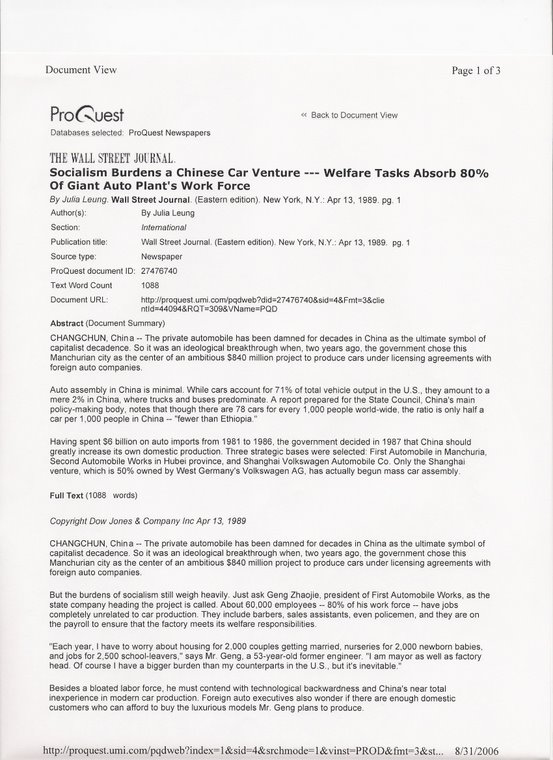
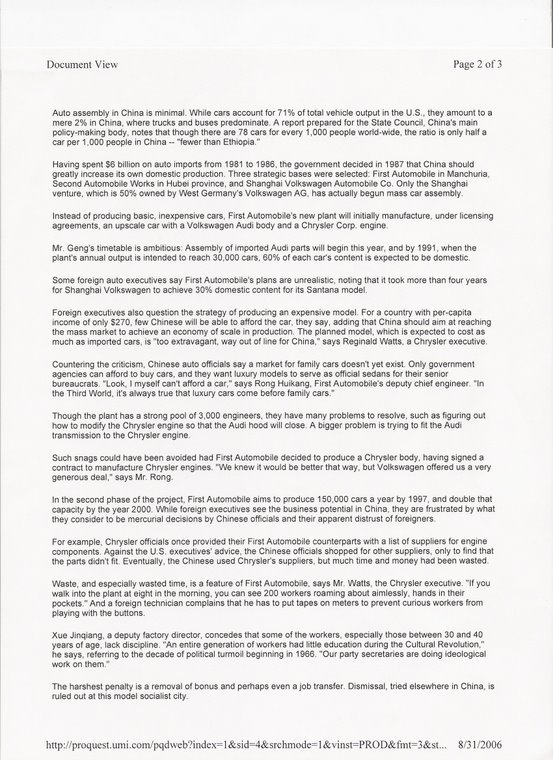
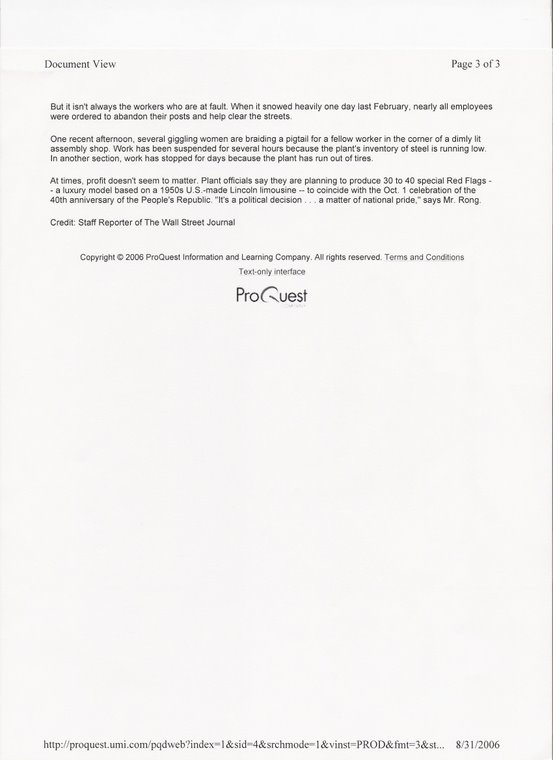
Shoddy journalism and shoddy construction... is there a path of corruption paved with dollars from the China to the United States?

In the story below, this is the kind of shoddy journalism we get here in the United States where chauvinism is passed off as "journalism from our great "free media."

First: Where is the photograph supporting this story?

It is not here, why?

Second: Many, many American scientists, architects, engineers, contractors, and construction workers have often been involved in these Chinese construction projects--- and manufacturing rebar--- in China, and the profits they have derived from construction have been fabulous.

When was the last time you ever read a news report in the Wall Street Journal with these money-grubbing capitalists proclaiming they were concerned about any "shoddy" construction they were involved in? Never.

There is no end to the most disgusting anti-communist, chauvinist and outright hate-mongering being spewed by the big-business corporate apologists passing themselves off as "journalists."

The snob actress and "movie star," Sharon Stone, whose claim to fame is giving everyone a peek at her little boobs in the movies and crying for a bunch of parasitic monks who need a numb-skull like the Dali Lama to do their thinking for them, rushed to the "aid" of the earthquake victims saying, "The Chinese people are being punished for the mistreatment of monks and the Dali Lama." These parasitic monks are worthless; their contribution to society is sitting around praying all day as servants wait on them hand and foot as if they are God's gift to the human race when all they are is a burden on society as the rest of the people are supposed to supply them with food while other servants feed them and even wipe their butts and push the gold-plated toilet handles and bathe them.

This has been the history of what passes for "journalism" whenever it comes to writing about human tragedy in socialist countries, be it the former Soviet Union, Cuba or people suffering hunger from drought in North Korea.

These "journalists" and their publishers find a way to gloat with glee at every opportunity no matter how catastrophic and tragic the suffering--- be the suffering due to drought, hurricane, volcanoes or earthquakes when tragedy and natural disaster strikes in a socialist country.

The manner in which these journalists report stories of flooding in Cedar Rapids, Iowa or hurricane damage in New Orleans is quite the opposite. Then it isn't about attaching blame, it becomes about praying for the victims.

These same "journalists" never question why our military doesn't put as much effort into helping people in our own country who are victims of natural disasters with the eagerness and rapidity they launched "Campaign Iraqi Freedom."

As someone who has worked construction in this country as both a roofer and carpenter on large and small projects, I could take "journalists" on a tour of some real "shoddy" construction projects if this is truly their concern.

Not once has our great "free media" had the courage to address the problems resulting in the deadly I-35W bridge collapse or question how it is that United States Congressman James Oberstar receives huge campaign contributions from some of the construction firms involved.

If our great "free media" were truly concerned with what might be "shoddy construction" in China these "journalists" should start to investigate the path of corruption paved with dollars from China back to the United States.

Some "journalist" might want to ask Sharon Stone why God is punishing our own victims of floods, hurricanes and tornadoes.

I wonder if a story has ever appeared in a Chinese newspaper asking why in the most advanced country in the world there is such shoddy construction that an improperly maintained levy broke causing flooding of an entire city; the result of one minor hurricane.

I would be willing to bet that in China, unlike here in the United States, there will be many full-fledged investigations to determine if in fact there was a problem with "shoddy construction" practices or the materials used in construction; perhaps there will even be an investigation to see if the rebar used was up to specs.

If these investigations find someone to be at fault I am sure there will be severe punishments meted out to those found guilty. If any form of corruption is found involving shoddy construction methods or materials I think I know what the punishment will be... unfortunately, those responsible for the collapse of the the I-35W Bridge spanning the mighty Mississippi River and those who allowed the levies in New Orleans to go without proper maintenance and repair will not receive the same ten-cent punishment.

Alan L. Maki


Sensitive China quake photo removed


Jun 15, 6:20 AM (ET)

By CARA ANNA


JUYUAN, China (AP) - A photograph hinting at shoddy school construction was pulled from an exhibition about last month's devastating earthquake, an apparent indication of rising government sensitivity over an issue that has already prompted angry protests from parents of children killed.

The photo showed a hand clutching a twisted piece of steel rebar that looked no thicker than a pencil, taken from the ruins of the middle school in the town of Juyuan that was one of 40 that collapsed in the May 12 quake.

The picture featured prominently among a collection of quake artifacts when it opened to the public last week. By the weekend, though, it was gone. Organizers were reluctant to say exactly why.

"We don't know if we were told to remove the photo," said Wu Zhiwei, assistant to the general manager of Museum Cluster Jianchuan, the organizer of the exhibit and the largest privately run museum in China. "And if we were told to remove the photo, we're not sure we could tell you."

School collapses have become one of the most charged issues in the quake recovery process, and one that local communist leaders seem anxious to suppress.

The entire state-controlled media have almost completely ignored the issue, apparently under the instructions of the propaganda bureau. Parents and volunteers helping them who have questioned authorities about the issue have been rounded up, detained, and threatened.

Juyuan has become a center of the collapsed schools issue, with police pulling grieving parents away from a courthouse where they knelt this month in an attempt to submit a lawsuit.

On Sunday, police cordoned off the area surrounding the town's collapsed middle school where nearly 300 students died, angering parents who had come to observe the 35th day of mourning, a key date in local tradition.

"It's as if we're bad people now," said a man who said he was the father of a dead student.

"This is our last chance to burn incense and they don't let us in," said the man, who declined to give his name, underscoring a growing reluctance to be publicly identified and possibly targeted by authorities.

Engineers hired to inspect the school rubble say many of the schools, including the one in Juyuan, were poorly sited and badly built. The government has promised to submit a report on the schools by June 20, possibly opening the door to charges or lawsuits.

Authorities are always suspicious of independent activism, however, and the possibility of being implicated in school problems offers officials a strong incentive to suppress information about such cases.

Despite the removal of the photo from Juyuan, the quake exhibit on a sprawling campus about an hour's drive from the provincial capital of Chengdu still offered potent reminders of the school tragedies, including schoolbook bags, smashed desks and children's shoes.

Identification cards, crushed appliances and hundreds of other personal items were pulled from the rubble and donated by military rescuers and volunteers. They were displayed alongside hundreds of photos of victims, relief workers and quake devastation.

The collection even included a megaphone said to have been used by Premier Wen Jiabao as he toured the ruins soon after the quake.

The exhibit ends with a wall of photos of about 2,000 people killed in the quake, China's worst natural disaster in a generation.

Visitors on Saturday said they found the exhibit both open and moving.

"It reflects the reality," said Hou Mincu, a retired professor from Sichuan's capital, Chengdu.

Zheng Chengzhi, a 42-year-old worker, was also from Chengdu.

"The earthquake isn't finished yet," said Zeng. "Construction and other issues, we need to talk about these things."

Friday, June 6, 2008

China appears to be heading towards democracy

Dear Colleagues,

We wish to share a beautifully written article on the development of democracy of China which appeared in the Irish Times on May 26, 2008 titled "China appears to be heading towards democracy." It is a moving presentation of people's attitudes towards the current government under Hu Jintao and Wen Jibao as reflected in the massive response to help in the aftermath of the earthquake. He describes the earthquake and its results in a heartbreaking manner with human content and without controversial political innuendoes. I believe you will share my feelings when you have an opportunity to read it.

You will note his quoting Nicholas Kristoff of the New York Times from his May 29th article titled "Terrorism and the Olympics." Kristoff begins with a compendium and critical history (though we do not challenge those facts) of China's exercise of police power. He then follows with his personal experience which shows SOME understanding of changes which are taking place in the growing openness and appreciation of the government's efforts to build the country while finding new forms of expression for the public attitude towards government.

Nonetheless, Tony Kinsella notes the changing attitude of Kristoff in support of his own more sensitive approach. We have included a copy of Kristoff's piece for your own evaluation.

Sincerely,

Sidney Gluck


Irish Times (5/26/08)

China appears to be heading towards democracy

By: Tony Kinsella

Four important indicators suggest China is starting to move away from authoritarianism, writes Tony Kinsella

IN THE early afternoon of May 12th last a massive earthquake devastated Sichuan. Its sheer scale - 90,000 dead and missing, 240,000 injured, five million homeless - pierced our human consciousness, affecting us on several registers.

Bertolt Brecht in his 1943 play The Good Person of Sichuan challenges the audience to find a workable balance between good and evil. Sichuan today poses a related challenge to us all. What has been crushed, and what has been born?

The tragic, heroic, images from Sichuan have been striking in their portrayal of a society sufficiently similar to our own as to be instantly recognisable - the constant media coverage, the heroic efforts of the emergency services, the army, NGOs and over 55,000 volunteers from all over China. The tragedies, the small heartening victories as survivors were disinterred, the exhorting presence of political leaders atop heaps of rubble that had until recently been homes, offices, and most poignantly of all, schools, are the familiar horrific normality of catastrophes.

The very existence of those images speaks eloquently of our planet's political evolution, and is thrown into stark contrast by the uncaring paranoia of the Burmese junta. If Naypyitaw is the heartless face of dictatorship, has Beijing begun to assemble a democratic profile?

Four important indicators are certainly pointing in that direction: transparency, rule of law, media independence, and the development of civil society.

Natural disasters were state secrets in the bad old days of Helmsman Mao, like the 250,000-plus who perished in the 1976 Tangshan earthquake. The official New China News Agency was reporting the Sichuan earthquake less than 15 minutes after it happened. That afternoon the state CCTV dropped its schedule to deliver live coverage.

Prime minister Wen Jiabao, followed by president Hu Jinta, flew to Sichuan, inspected, encouraged, exhorted, apologised and threatened - live on television. CCTV news anchor Zhao Pu failed to contain his tears as he described the earthquake. A remarkable transition from the Tangshan statement of Mao's widow, Jiang Qing: "There were merely several hundred thousand deaths. So what? Denouncing Deng Xiaoping concerns 800 million people."

Beijing businessman Zhao Shuangying (48) walked into the headquarters of the Red Cross Society of China on May 15th to donate EUR 10,000. "It's very simple," Mr Shuangying said, "I cannot go to Sichuan, so I came here to help." If he, and hundreds of thousands like him across China, did not have confidence in their country's legal system, they would not be propelling their country's economy forward at about 10 per cent a year.

Two days after the earthquake, bureaucrats at the central committee's propaganda department ordered Chinese media not to deploy any more journalists to Sichuan. This was likely more of a reflex action as Chinese and foreign journalists streamed into Chengdu and beyond. Obedience to such edicts used to be the norm.

One local editor advised his journalists: "If everybody pays no attention to this, then it won't really be a ban," and how right he was.

The Shanghai Securities News, a service of the state Xinhua Agency, wrote of the need to respect seismic building codes and called for an end to corrupt building practices - a courageous demand for political reform. Prof Min Dahong of the Chinese academy of social sciences observed: "This is a good opportunity to establish a system that will encourage the press to report in a timely and open manner."

Alexis de Tocqueville, impressed by the then activism of US public life, said in 1856 that "the health of a democratic society may be measured by the quality of functions performed by private citizens".

More than 55,000 volunteers have rushed, at their own expense, to Sichuan. Hao Lin, a psychologist, told his wife he was going to Guangzhou (Canton) before hopping on a plane for Chengdu and cycling into the disaster zone to offer counselling.

Li Xiaotang and 14 other young professionals from Shanghai met on the internet to organise their seven-hour journey to Feishui. She and her friends took a week's unpaid leave, and spent a month's salary each to fund their travel and purchases of food, medicines and mobile phones. Private citizens queued across China to donate blood, blankets, food, tents and more than EUR 400 million. Dubliner Peter Goff has helped ship 16 tons of donated material through his Chengdu Bookworm café.

By de Tocqueville's measure, Chinese democratic society is in very bonny health.

The Peoples' Republic of China is far from full democracy, and its communist party still clings to political power with a firm, if increasingly flexible, and probably quite frightened, fist.

China seems embarked on its own version of the long, awkward and occasionally brutal road away from authoritarianism towards something more democratic. Indonesia, South Korea, Taiwan, Singapore, Pakistan, Mongolia and other Asian countries have already travelled further along similar routes.

New York Times columnist, Nicholas D Kristof wrote on Thursday last that he could see the Chinese Communist Party ". . . becoming a social democratic party that dominates the country but that grudgingly allows opposition victories and a free press".

Will the new China have a unicameral parliament like Sweden, or an appointed upper house like the UK? Will it be federal like Germany or the US? Or will it reach back into its three millennia of political history to develop something new?

In a reversal Brecht would have loved, it will be up to the good people of Sichuan to judge.


---------------------------------------------------------------------------

May 29, 2008
Op-Ed Columnist

Terrorism and the Olympics

By NICHOLAS D. KRISTOF
KASHGAR, China

The reports of terror plots emanating this year from this Muslim region in the far west of China might seem fanciful: A foiled plot to blow up a plane; a cache of TNT to bomb the Summer Olympics; even a “violent terrorist gang” that planned to kidnap Olympic athletes.

But these aren’t whispers on the Internet. They’re reports coming from the Chinese government. So I flew out here to Kashgar — an oasis on the ancient Silk Road, where the minarets and camels and carpets provide a Middle Eastern ambience — to look for terrorists.

Instead, China’s State Security Ministry found me. I had been in Kashgar just a few hours when my videographer, who is ethnically Chinese, called to say that two plainclothes officials were interrogating him. They asked him not to tell me since American journalists tend to be touchy about such things.

The interrogation was a sign of the authorities’ anxiety about stability in China’s Muslim west. Separatists here in the Xinjiang region aim to create the nation of “East Turkestan” and have periodically blown up police stations — even bombed three public buses in 1997.

The Chinese government has claimed that 162 people were killed in such terror attacks by Uighur separatists between 1990 and 2001. Meanwhile, China has sentenced more than 200 people to death since 1997 for engaging in such separatist crimes.

Last year, Chinese officials said that 18 people had been killed when police raided a Uighur terrorist training camp with ties to Al Qaeda. The raid netted 1,500 grenades.

Then in March, China announced that it had foiled a plot “to create an air crash,” in a passenger plane shortly after it took off from the Xinjiang capital of Urumqi. In April, the authorities said that they had confiscated explosives from Uighurs who were planning suicide bomb attacks.

“This violent terrorist gang secretly plotted to kidnap journalists, visitors and athletes during the Beijing Olympics,” The Associated Press quoted Wu Heping, a spokesman for the Public Security Ministry, as saying.

Then just this month, a crowded bus blew up in Shanghai, killing three people and injuring many more. No one publicly claimed responsibility, but it recalled the 1997 Uighur bus bombings.

Ronald Noble, the secretary general of Interpol, cited these incidents — and also reports of a separatist plot to disrupt the Olympic Games with poison gas — and told a press conference that a terror attack at the Olympics was “a real possibility.”

It’s not entirely clear what to make of all this, for as I strolled around Kashgar I found the situation remarkably calm. I wasn’t expecting to uncover a terrorist cell, but I had anticipated more hostility toward the government. Ordinary Uighurs I spoke with offered measured complaints, but they weren’t seething as Tibetans are.

“Nobody likes it when the Chinese all move in here,” said a Uighur shop-keeper. “Of course, we’re all upset. But what can we do?”

One young woman offered a different take. “When I was a little kid, my mom would tell me, ‘Don’t wander or the Han Chinese will steal you away. They eat human flesh.’ ” She laughed and added: “But now we see more Han, and we’re not afraid of them. Relations are O.K.”

Some young Uighurs criticized the Beijing Olympics, saying the Games will drain local budgets. But I could have found stronger anti-government sedition on any street corner of Manhattan.

The only excitement I found in Kashgar was playing pied piper to State Security officers who tailed me whenever I left the hotel.

Normally, the Chinese government downplays security risks, but human rights groups argue persuasively that China is using concerns about Uighurs as an excuse to crack down on peaceful Uighur dissidents. After 9/11, China declared its own war on terror in Xinjiang, but Human Rights Watch and Amnesty International have documented that this often has targeted Uighurs who are completely nonviolent.

Unfortunately, the Bush administration has largely backed this Chinese version of the war on terror. Indeed, a Department of Justice report this month suggests that American troops softened up Uighur prisoners in Guantánamo Bay on behalf of visiting Chinese interrogators. The American troops starved the Uighurs and prevented them from sleeping, just before inviting in the Chinese interrogators.

That was disgraceful; we shouldn’t do China’s dirty work. It was one more example of the Bush administration allowing the war on terror to corrode our moral clarity.

We should encourage China to tolerate peaceful protesters even as it prosecutes terrorists. But instead of clarifying that distinction, in recent years we have helped China blur it. The risk of terrorism during the Olympics is real, but that shouldn’t force us to do violence to our principles.


Op-Ed Columnist - Terrorism and the Olympics - Op-Ed - NYTimes.com

Tuesday, March 25, 2008

Press Distortions and Promotion of Anti-China Opinions

Note: Please note a correction to this original posting, and a very pertinent link to further information.

The press distortions and promotion of anti-China opinions and incidence suggest a pattern with the purpose of embarrassing China in an effort to counteract the positive effect which its hosting the 2008 Olympics will have on its global reputation. Millions around the world will see the capabilities of a country that has witnessed centuries of travail and has emerged as a contender for world recognition of its contribution to development.

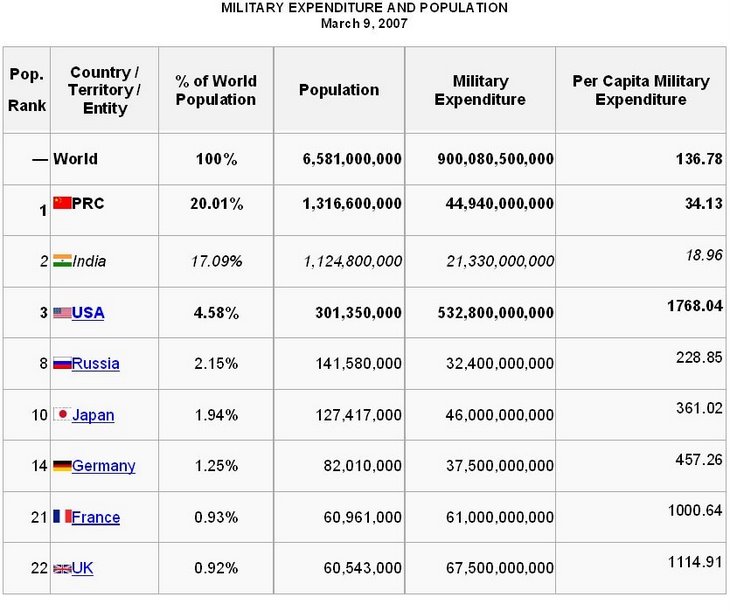
A sequence of events began some months ago with the Dalai Lama’s visit to the State Department. Subsequently, there were alarmist reports of China’s doubling its military expenditures and notes on Spielberg’s resignation as Artistic Advisor for the 2008 Beijing Olympics as an objection to an accusation that China was supporting dissension in Darfur (though, quite the opposite was true in its collaboration with the United Nations). The children’s toy fiasco went by with little mention of the apology by Mattel for its influence which apparently was based on cost calculations to avoid higher prices. Presently, the sudden eruption of destructive events by Buddhist demands for separation caused a degree of violence that was answered by the Chinese authorities as it might have been in any other country, we then learned that thousands had NOT been killed in the melee.

This disruption will blow over as other have. The Spielberg incident on China’s policy towards Africa (a distortion of fact) has melted away in the light of its principle of peaceful economic relations for the mutual benefit of both countries. Time will show that the Tibetan incidents will be exposed in a peaceful manner.
Please note the correction and explanation to this inaccurate statement below:
The Chinese government is now considering the question of whether they wish to administer Tibet, which had been turned over to them by the British four-hundred years ago who turned down its occupation because it didn’t pay off.


True, efforts are being made by the US in some areas to accommodate China’s rise as an economic rival. This is understandable since China has the advantage of learning much from capitalism, building its productive forces while simultaneously introducing economic planning and regulating the movement of capital and pricing structures in its socialist market economy. They have enough problems dealing with accommodation to private ownership at the same time that they build up conditions of the working class. Their objective is to form a Harmonious Society which includes private property, entrepreneurism and the social welfare of the working population in peaceful solutions to differences between these groups. In the past two years, 75% of foreign owned enterprises have signed union contracts. The unions are asking for a schedule of wage increases depending upon time and tenure of members of the work force. This is only one incident of differences which will have to be resolved in manners that differ from the union experiences in the United States from Hay Market in the 19th Century through the first half of the 20th.

We believe that the success of the 2008 Olympics with the special beauty of Chinese cultural structures and modern touch will bring more peace to the world as it opens its eyes to reality and lessens the possibility of military conflict.

*Those who read this have a right to disagree; I invite comments and differences of opinion but simultaneously expect readers to have an open mind and consider this point of view.

Sidney J. Gluck
New York City
March 25, 2008

Note: In order to encourage dialogue we will publish your opinions and Sidney Gluck's responses as part of this blog.


A CORRECTION TO THE BLOG OF MARCH 5, 2008
“DISTORTIONS IN THE PRESS RE: CHINA-TIBET”


Dear Friends,

I wish to acknowledge a correction to a reference in my last essay on the media and China called to my attention by a number of respondents.

I stated that administration of Tibet “had been turned over to them (China) by the British four-hundred years ago when its occupation no longer seemed prosperous.” This is incorrect. This concept emerged from talks and lectures I had been to over the years - not from my reading. I’ve since done my homework.

While it is true that the British, especially in the 19th and 20th Century, were involved in Tibetan affairs its influence was washed away as imperialism withdrew its control of China after 1912. The relationship between Tibet and China had been cemented for over 400 years long before the present government undertook administration of the province. In the 17th – 19th centuries, two rival Tibetan Buddhist schools were vanquished by the Lhasa school which had established the position of Dalai Lama as the religious leader who, at that time, had civil relations with the Mongols, Russians and Chinese. A change of civil relations occurred when the fifth Dalai Lama visited the Manchu emperor, Shunzhi, in 1652 in Beijing and received the seal of provincial administration without being required to kowtow. From this point on, Tibet is continuously linked with China. It was not the British who abandoned Tibet to the Chinese, but the Tibetans who linked themselves to Beijing through civil authority.

This information is published on wikipedia.com

http://en.wikipedia.org/wiki/History_of_Tibet

We attach the table of contents from the hyperlinked page for your perusal. You will note shifts in various centuries during which Tibet’s relationship with Beijing is a relative constant in the background (this information is found in sections 9, 11 and 15).

Tibetan history is replete with political and religious interference up until the present day. At the same time, China’s presence has continued regardless of their own lack of modernization, a situation which has changed under the present regime of the CPC which, in developing the country as a whole, has included economic changes in Tibet. These economic changes aren’t anti-Tibet, but they are positive developments of forces of production and exchange which include an increase in Han participation. Historically, it is a fact that until the Chinese Communists gained control of the central government, a conflict developed between the religious leadership of Tibetan Buddhism and the growth of secular political relations

Without making a judgment at this point for my readers and friends, I recommend that you check the history of Tibet as noted above, especially sections 11-14 and then sections 15-21, the latter dealing with the current situation.

As I write to you, Wen Jibao, the Premier of China’s National Congress and number two in the political hierarchy, has issued a public statement that the Dalai Lama is welcome to come to Beijing and set only one condition: that he does not advocate separation of Taiwan and Tibet from the PRC. I suppose, should he go to Beijing for discussions, it is possible to arrange for his position as a religious leader to be respected and conversely that the religious community would respect the national economic and political restructuring and authority, both provincial and central.

To those of you who did communicate, I wish to thank you and assure my friends that I will be very careful to fact-check my memory and reexamine any questionable information.

Sidney J. Gluck
New York City
April 3, 2008

Tuesday, January 29, 2008

Museum entrance fees in China eliminated

http://news.xinhuanet.com/english/2008-01/29/content_7516590.htm

2008-01-29
Museum entrance fees

BEIJING, Jan. 29 -- It should not have taken so long. But finally it has
arrived. By 2009, except for some special historical buildings and ruins,
all public museums under the jurisdiction of the cultural authorities will
stop charging entrance fees.

No doubt this is very good news for overseas tourists, who might otherwise
be confused by the functions of our public museums.

For museum visitors in particular, the waiver will make their China
experience richer, yet a lot cheaper. If the decision-makers did not have
foreign guests in mind when they worked on the project, this is a huge
bonus. Free access to the variety of museums will facilitate outsider
appreciation of our peculiar history and culture.

Our curious guests deserve to know how much more this country has to offer -
much more than fancy delicacies and inexpensive silk.

The authorities have spent a lot in the past year on campaigns to promote
cultural understanding overseas. There were big-budget exhibitions and shows
of all kinds.

Offering free access to public museums, as we see it, is a cost-effective
supplement and a boost on the home front to those endeavors of promotion.

The foremost beneficiaries, however, are the average Chinese.

In the first place, we see an additional sign that public finance is truly
being re-oriented to upgrade public welfare. It is reassuring to see the tax
levied on us is being allocated in a more sensible manner. Our State coffers
are capable of providing more for public-interest undertakings. It is good
to see public museums getting their due share.

Museums are great venues to help nurture a basic sense of our culture and
history. This is essential for a shared sense of identity.

Entrance fees might not be the only cause of the generally low visitor flow
at our museums. But they suffice to prevent many from visiting.

The irony is while most charge for entrance, few public museums are living
on box-office revenues.

Instead, many continue to rely heavily on government subsidies. And they
keep crying for more.

There is no better remedy than the State assuming full financial
responsibility for such facilities.

Good to see the government is finally standing out.

Wednesday, December 12, 2007

Socialist Core Value System

Note: The Comments below are from Sidney Gluck and the three following papers contain Sidney's notations in thinking about all of this.

Left-Click your cursor on the three documents to enlarge them to be able to read them.


Comments on Resolution Promoting
Socialist Core Value System

November 16, 2006


The Hu Administration, in order to combat the negative human nature that has permeated much of the Eastern and Southern industrialized regions of China during the past twenty-eight years of operating under the Deng Xiaoping slogan, “To Get Rich is Glorious” has initiated an ideological campaign to lay the basis for “the moral foundation of social harmony to steer the country on a Socialist Road.” This concept was first publicized at the recent 6th Plenum of the 16th CP Central Committee. The objective at this stage is to combat the human nature of private acquisitiveness and emphasize a collective identity of human nature. This is the sharpening of the present stage in a far-sighted process of the growth of socialism. It is an active application of Marxism in this moment of history in China’s national development.


Attached is a resume including President Hu Jintao’s contribution of “The Eight Honors and Disgraces in the Socialist Core Value System”


Thursday, November 29, 2007

MAO: A LIFE by Philip Short

This is being published in the interest of creating dialogue and discussion.

Thursday, November 29, 2007

EVERYTHING YOU EVER WANTED TO KNOW ABOUT MAO (16 finis)

MAO: A LIFE by Philip Short, New York, Henry Holt and Company, 2000. 782pp.

Reviewed by Thomas Riggins; BA (Anthropology & Archaeology), MA, MPhil, PhD (Philosophy) currently university lecturer in philosophy and ancient studies

Thomas Riggins has a blog: http://leninlives.blogspot.com/


EPILOG

Short's epilogue is a mixed bag. It was written around eight years ago in 1998 or 1999 so some his ideas about "capitalism" in China may be dated. But to the point.

About a month after Mao's death Hua Guofeng arranged to have the Gang of Four arrested and removed from power. Within two years Deng had been both rehabilitated and had ousted Hua from power.

Short says Mao was correct in his view of Deng Xiaoping. Deng "was a 'capitalist-roader all along -- and the moment he was in a position to do so, he began dismantling the socialist system Mao had built and putting a bourgeois dictatorship in its place. There was indeed a bourgeois class within the Communist Party and the country did indeed 'change its political colour.'

The problem with this assessment is that at the time of Mao's death and Deng's rise to power, there was no bourgeoisie in China capable of coming to power. Neither Deng nor any other CPC leaders or functionaries owned the means of production in China-- which were basically state owned or owned by communes. In terms of a Marxist understanding a bourgeois dictatorship in China would have been impossible. Even today, while a bourgeois class has come to exist in China, it is far from having control of the state apparatus.

Deng and the CPC embarked on a program to modernize China simply because the anarchy of he Cultural Revolution (and the general backwardness of the country) had left the economy in shambles. Socialism requires an advanced modern economy to have any chance of ultimate success. The CPC under Deng made a quite orthodox decision to open up China and use the market (ultimately controlled and directed by the state) to overcome feudal backwardness. This was a process initiated by Mao himself when he invited Nixon to visit.

In 1981 the CPC rendered a verdict on Mao's role. It was the same verdict he himself had rendered on Stalin-- i.e., he was 70% correct and 30% wrong in what he had done. Short spends a lot of time going over the question of how many people died as a result of Mao's policies. The numbers who died under Hitler, Stalin, and Mao are compared.

These numbers are all contentious and ultimately meaningless and unverifiable. Great historical transformations are not the result of this or that individual. Revolutions and wars are like hurricanes and earthquakes. They break out as a result of forces and pressures that build up over time and are ultimately independent of the human will. Is Lincoln responsible for all the deaths of the Civil War? Is President Johnson, this one foolish individual, the cause of all the deaths from the Vietnam War?

Neither Stalin, Mao nor Hitler ever personally killed anyone.[It is actually obscene to compare Hitler with Mao or Stalin]. Would their policies have been possible without the mindset of the people who followed their leadership and shared their values: a mindset created by the previous history of Russia, China and Germany and the development of capitalism and imperialism. Is Adam Smith responsible for all the deaths due to the transformations brought about by the wars over markets and resources waged by the invisible hand?

These two sentences from Short point up the confusions. Mao's "rule brought about the deaths of more of his own people than any other leader in history." "The overwhelming majority of those whom Mao's policies killed were unintended casualties of famine." The fact they were unintended, Short says, "puts him in a different category from other twentieth-century tyrants."

Individual leaders must of course accept responsibility for their actions. But the contexts that they are forced to confront cannot be ignored. That is why when all is said and done, Short is correct to conclude that, "A final
verdict on Mao's place in the annals of his country's past is still a very long way off."

This view is the view of most of the Chinese themselves. It is echoed in the special issue of Beijing Review of October 5, 2006 on the 30th anniversary of Mao's death ["Mao Today: How does his legacy still influence China?"]

His legacy is really "in flux." One article tells us how "the little red book" is used by the new Chinese capitalists for inspiration! One was able to get market share from foreign capitalists "by adopting Mao's military tactic of 'using the countryside to encircle cities.'" It seems many Chinese companies urge their workers to study Mao for his "spirit of rebellion" and innovative thought. This information comes from a section entitled "Mao as business guru." If US corporations want to remain competitive, I suggest their CEO's start reading Mao at once!

Elsewhere the article says the poor read him because they want to regain the social benefits lost in recent years. A university professor is quoted: "Mao is still the most popular among the farmers, many of whom face growing hardship 'Through holding memorial activities for Mao, the farmers hope the gap between urban and rural areas will narrow.'" Mao as a god!

I will conclude with a quote from Gao Hua of Nanjing University: "Mao's phenomenon is the outcome of China in a transitional period, from an imperial country to a republic . At the turn of the new century, China is facing new challenges , which requires new thinking and new systems. So all the reflections on Mao should be future-oriented."

Monday, September 10, 2007

Professor Marquit Lectures on Social Justice in China--- ignores social justice for U.S. Workers in his own back-yard

The Distinguished Professor, Erwin Marquit, to speak on Social Justice... here we have a learned professor who has refused to address the issue of social justice when it comes to the Ford Motor Company making the decision behind the closed doors of its corporate boardroom in Detroit, Michigan to close the St. Paul Ford Twin Cities Assembly Plant which will throw two-thousand autoworkers out onto the streets… without a peep of protest from Professor Erwin Marquit; and, he is going to lecture about the quest for social justice in China by way of something called the "socialist market economy."

I would encourage a big turnout for this lecture.

Saturday, 9/15, 10 to noon, Women's International League for Peace and Freedom hosts U of M prof Erwin Marquit, talking about "The Quest for Social Justice in China's Socialist Market Economy," Van Cleve Community Center, 901 - 15th Ave SE, Mpls. www.wilpfmn.org


Ask the Professor about the role of capitalist corporations in China and how they are trying to put China on the road to capitalism and counter-revolution.

Ask the Professor what he thinks of Ford Motor Company closing the St. Paul Ford Twin Cities Assembly Plant while moving much of its U.S. operations to China.

Ask the Professor what he is doing to try to halt the closing of the Ford Twin Cities Assembly Plant while Ford has opened manufacturing facilities in China.

Ask the Professor when was the last time he met with Ford workers to discuss the need for public ownership in relation saving the Ford Plant.

The distinguished Professor Marquit is one big hypocrite when it comes to social justice for working people in China or the United States.

There is no such thing as a “socialist market economy;” socialist economies can only be planned economies… part of the plan might include allowing capitalist corporations to operate in the country; however, Communists never allow these capitalists and their “market economic system” to take over, and dominate, the economy--- socialist economies can only be “planned economies” (there is no other kind of socialist economy)… “socialist market economyis a code phrase for capitalism and counter revolution.

There can only be social justice for working people through a planned socialist economy. Look, it is not hard to figure out that Erwin Marquit has no concern for social justice for working people when he is opposed to taking any action--- legislative and/or mass action (we need a combination of both)--- right in the very city where he lives concerning the Ford Plant closing… what can such a professor who doesn’t even have any compassion for social justice for two thousand working people in his own community know about social justice for working people in China? This is such a basic and fundamental question it boggles one’s mind to think that anyone with even half a brain would pay any attention to a professor with such a perverted and distorted view of Marxism.

Show me anyone promoting a “socialist market economy” and I will show you a charlatan and a fraud… if that person purports to be a Marxist.

For years Professor Marquit has used his academic position to foster a perverted view of Marxism with the intent of confusing working people about what socialism is in the United States, Poland, East Germany--- and now in China.

I don't know of workers anywhere in the world who are dumb enough to believe they can attain social justice through any kind of "market economy."

I have spoken with many Chinese business people and they don't speak of "market socialism." They speak of "free market capitalism." Of course they are all for this... they are getting rich exploiting Chinese workers who are suffering.

Anyone can see that China's working peoples' present problems stem from capitalist corporations being allowed to operate without any controls and restrictions placed on them while dictating economic "reforms" in China. Producing goods and services using cheap, highly exploited labor where working people suffer the most disgraceful abuses at the hands of those extolling the virtues of the "socialist market economy" is the reality.

That a prominent and respected organization like the Women's International League for Peace and Freedom would give Professor Erwin Marquit a forum for his perverted and distorted Marxist views without him having to participate in a forum where his views could be challenged is a disgrace.

Professor Marquit parades around the world professing to be a Marxist proponent of the "socialist market economy" only when he has no opposition... he creates his own caricatures which he purports to be his opposition (coincidentally, all his caricatures resemble Joseph Stalin)... then he proceeds to demolish them; but, Marquit never has the intellectual honesty or courage to debate a living, breathing human being... much less a worker.

Certainly the Women's International League for Peace and Freedom must understand that Professor Marquit's views on the "socialist market economy" are highly controversial... why then, would Marquit be allowed to pontificate his fairy tales without any opposition like a Catholic Priest at Sunday Mass?

Certainly the Women's International League for Peace and Freedom must be aware of the Minnesota corporation Mattracks which has a small manufacturing facility in northern Minnesota opening up a plant in China five times the size of its Minnesota operation to make equipment for "crowd control"... all financed with Pentagon funding obtained by Minnesota's only "Blue Dog" Democrat, Collin Peterson. Just what kind of "crowd control equipment" might the Pentagon be interested in financing? But, to use the tax-dollars of the American people in order to allow this corporation's bottom line to grow fat just so Collin Peterson can get a bigger campaign contribution is a disgrace and an insult to Minnesota workers who will suffer the social injustices associated with poverty wages and unemployment... the direct result of the so-called, mis-named, "socialist market economy."

Capitalists and their cronies like Professor Marquit are always trying to give capitalism a different face by playing with words. But, to go so far as to call capitalism "socialism," as Professor Marquit does, is the epitome of deceit and dishonesty.

There are tremendous debates presently underway in China with Chinese working people dead set against any further attempts by capitalist corporations and their hoax of "market socialism." Chinese workers understand "market socialism" means counter-revolution, not the planned socialist economy they have struggled to create and improve.

It is unfair to allow the proponents of "market socialism" to pontificate their views without allowing alternative views to be expressed.

I have offered to debate this learned professor on this issue many times... his response has been to initiate a dirty, name-calling, slanderous campaign against me.

Professor Marquit should not be given a forum for his views before any organization until he is willing to have his views challenged in a real debate.

I would urge people to attend this lecture by Professor Marquit to challenge his quackery which makes a mockery of scientific socialism.

This is from the Women's International League for Peace and Freedom's web site:

Saturday, Sept. 15, 2007, 10 am to noon.

“Coffee With”: The Quest for Social Justice in China’s Socialist Market Economy
Speaker: Erwin Marquit, professor emeritus, U of M, leader of study tours to China
and Vietnam

Van Cleve Community Ctr., 901 15th Ave. SE, Mpls

FREE ­ EVERYONE WELCOME

FFI: 651-458-7090; www.wilpfmn.org

China’s mixed market economy has led to social problems such as pollution, hazardous working conditions, loss of free health care and education, and a growing income gap between rich and poor. However, besides cutting the number of people living below the poverty level, it has also raised the average standard of living, life expectancy, and educational levels. Drawing on recent extended visits to China, the speaker will address the question of whether the current Chinese policies of economic development will enhance or obstruct its quest for social justice.


I would suggest Professor Marquit spend a little time talking to Ford workers in his own home town and make a trip up to Karlstad, Minnesota and talk to working people who are unemployed and employed at poverty wages there... what Professor Marquit will find is that "market socialism" is robbing U.S. workers of jobs while creating misery for Chinese workers who will be employed under prison-like conditions, forced to live like rats in a "dormitory" where they will be robbed of their earnings to pay exorbitant rents, and have to eat slop in the company cafeteria--- again, with the cost of meals deducted from their miserly, poverty-wage pay-checks--- all very reminiscent of the "company towns" on the Iron Range in the early 1900's.

Professor Marquit likes to indulge in grand utterances about "market socialism" which have little connection to real world realities... just like some Chinese officials who have abused their positions in the Communist Party and the Chinese government to evade any real discussion about social justice for working people.

In fact, Chinese workers, many of whom are members of the Communist Party of China, are beginning to wage a determined struggle to reclaim the socialist road and the adherence to a planned socialist economy in quest of the social justice they have struggled for; they have had it with the charlatans posing as Communists and government officials who pad their pockets with bribes from capitalist corporations along with American Professors be they from the American Enterprise Institute or the University of Minnesota. Professor Marquit has written these workers, and their struggles for social justice off as "Stalinist."

When it comes to real socialism, Professor Marquit has some very real problems of his own... all he can see is the ghost of Joseph Stalin every time he hears the words, "planned socialist economy;" and every time he hears the term "workers' power" he sees the ghost of Gus Hall.

The day Ford workers determine the future of their plants and what will be manufactured according to what society needs, and American tax-dollars are invested creating jobs for U.S. workers in northern Minnesota in communities like Karlstad as Chinese and American workers make the decisions to cooperate in joint ventures--- this will be the day working people can rejoice in having attained real social justice... and this day will only come when we create a planned socialist economy... just like the Chinese people set out to do when they overthrew the feudal lords and routed the imperialists.

Alan L. Maki